
Georgian cuisine represents one of the world’s most distinctive and historically rooted culinary traditions, characterized by bold flavors, unique bread-and-cheese preparations, and a profound cultural emphasis on communal dining. The country’s location at the intersection of Europe and Asia, combined with its ancient winemaking heritage and regional diversity, produces dishes that reflect thousands of years of cultural evolution and culinary innovation.
The Essential Bread and Cheese Foundation
Khachapuri, Georgia’s national dish, transcends the category of simple bread—it embodies the country’s culinary identity and exists in remarkable regional variations. The most common form, Imeruli khachapuri, presents a round flatbread filled with melted cheese and baked until the exterior becomes crispy. The preparation requires fresh Georgian cheese (typically sulguni, a semi-hard white cheese with mozzarella-like properties) mixed into the dough, then baked in traditional clay ovens until the crust achieves deep golden-brown color.
Adjarian khachapuri, the boat-shaped regional specialty unique to the Adjara region near the Black Sea in Batumi, represents khachapuri’s most visually distinctive and indulgent form. The distinctive eye-shaped or boat-like bread contains an enormous pool of melted cheese and butter with a raw egg resting atop, creating what can only be described as an edible architectural statement. The traditional consumption ritual involves tearing pieces of bread from the boat’s edges, dipping them directly into the melted cheese-egg mixture, then stirring the egg to semi-cook it into the cheese. Laguna Restaurant in Batumi (located on 26 Maisi Street/May Street, near the Art Museum) serves the most acclaimed version, with a “Signature Dish” featuring ham, egg, cheese, and butter. The restaurant operates in steps descending from street level, and khachapuri costs approximately 9-11 Lari (roughly $3-4 USD) for the most elaborate preparation.
Svaneti’s regional variant, Petvraali, distinguishes itself through the addition of millet and wild caraway flowers to the traditional cheese filling, incorporating these grains because millet provides sustained energy during harsh mountain winters when villages become isolated by snow. Lobiani, a less internationally recognized but equally essential khachapuri cousin, substitutes kidney beans (lobio) for cheese, creating a fasting-period dish with deep earthy flavors. The combination of mashed kidney beans seasoned with onions, garlic, and spices inside fluffy bread produces what numerous travelers describe as more satisfying than any contemporary vegetarian sandwich.
Soup Traditions: Depth Through Spice and Walnut
Kharcho represents Georgian soup culture at its most complex. Traditionally made with beef on the bone simmered for hours, the soup combines walnut paste (ground walnuts provide essential body and richness), sour plum purée called tkemali, and the distinctive Georgian spice blend khmeli suneli, which includes coriander, fenugreek, and other warming spices. Regional variations prove significant: Megrelian kharcho (from the Samegrelo region) transforms into a thick stew served over ghomi (cornmeal polenta) rather than as a broth, eliminating rice entirely and intensifying the walnut-based sauce. The plum’s sourness provides critical balance against the richness of walnuts and fatty beef, while modern adaptations sometimes add pomegranate juice or tomato sauce based on local preference. Authentic preparation requires minimum preparation times of 2-3 hours of simmering. Mapshalia, a traditional Megrelian restaurant in Tbilisi, serves exceptional kharcho paired with elarji (fried polenta balls) for mopping the sauce.
The Dumpling Tradition: Khinkali and Kubdari
Khinkali, Georgia’s beloved soup dumplings, originated in mountain regions as an economical method of feeding large families with minimal ingredients. Mountain shepherds originally used lamb, cumin, salt, and pepper; modern versions predominantly employ beef or pork. Each khinkali contains juicy seasoned meat and, critically, hot broth trapped inside the dough pouch—the signature eating experience involves sucking the broth from a small pinched opening at the dumpling’s top before consuming the remainder. Variants include Mtiulian khinkali (beef and pork without herbs), Tushetian khinkali (beef or lamb, sometimes with spinach, avoiding pork for regional cultural reasons), and versions filled with mushroom, potato, or cheese. Café Daphna (29 Atoneli Street, Tbilisi) earned recognition as a khinkali specialist where each dumpling is hand-crafted with precise pleating at the crown.
Kubdari, Svaneti’s iconic meat pie, elevates simple dough-and-meat preparations through the exclusive use of Svaneti salt, a proprietary spice blend featuring blue fenugreek and dried coriander unique to the high Caucasus mountains. The preparation involves kneading light, airy dough, filling it with chopped (not minced) beef or pork seasoned with onions, garlic, and Svaneti salt, then baking on wood-fired stoves until edges crisp before finishing in traditional ovens. The meat maintains its texture and juiciness because chopping (rather than grinding) prevents meat fibers from breaking down into paste. Lali’s Guesthouse in Mestia, Svaneti, offers authentic kubdari preparation classes where visitors learn the technique directly from locals—this experience combines education with genuine cultural immersion.
Meat Preparations: From Garlic Decadence to Grilled Simplicity
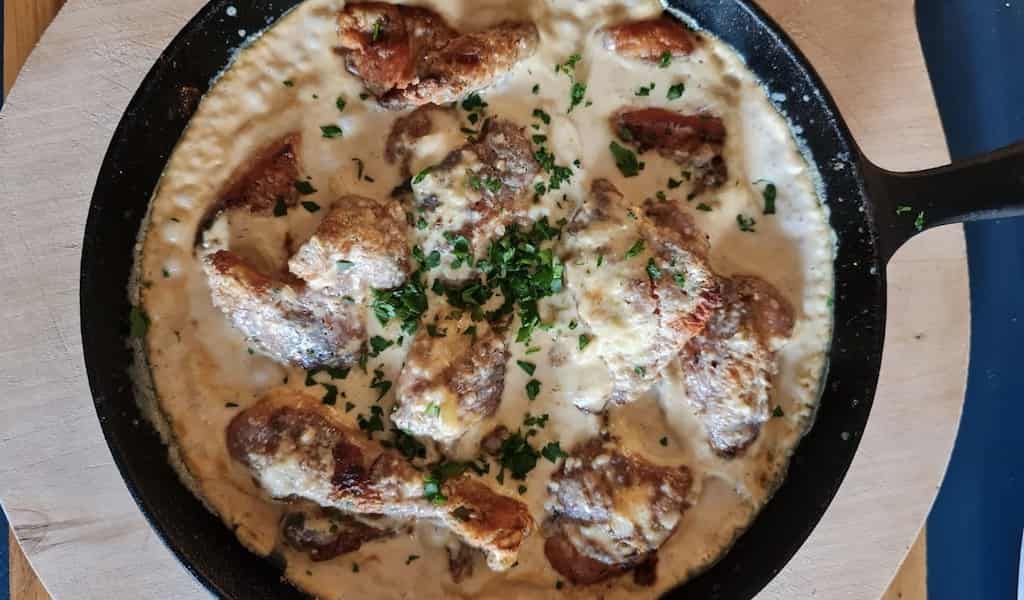
Shkmeruli, Georgia’s breath-defying garlic chicken masterpiece, originates from the tiny village of Shkmeri in the Racha region of northwestern Georgia. The dish presents butterflied chicken seared until skin turns mahogany-brown, then finished in a sauce of melted butter, cream, and prodigious amounts of minced garlic—10-12 cloves for a single chicken produce an intensely aromatic, creamy sauce that clings to tender meat. The traditional serving vessel, a clay ketsi (earthenware dish), maintains heat and reflects the dish’s rustic authenticity. Preparation requires initial high-heat searing to develop crispy skin and render fat, followed by oven finishing at 200°C (400°F) to ensure even cooking before the cream sauce is added. Salobie Bia (14 Ivane Machabeli Street, Tbilisi) serves the legendary version alongside preserved tomato salads and tkemali (sour plum) sauce.
Satsivi, the cold poultry dish in walnut sauce, evolved into Georgia’s quintessential holiday preparation. Boiled chicken or turkey (traditionally turkey for Christmas feasts) submerges completely in a cold walnut sauce made by grinding walnuts to fine paste, then combining with garlic, fenugreek, coriander, cinnamon, vinegar, and cayenne pepper. The sauce achieves the consistency of heavy cream; vegetarian variations substitute eggplants or cauliflower for poultry. The dish requires advance preparation—chicken must cool completely before combining with sauce, then the entire preparation refrigerates for 4+ hours or overnight to allow flavors to marry. The combination of warming spices with cold temperature creates an paradoxical sensory experience characteristic of Georgian cuisine.
Mtsvadi, the Georgian term for any meat grilled on skewers, represents the country’s answer to international shish kebab traditions. In Georgia, pork dominates as the preferred meat, though beef, lamb, and chicken variations exist. The Kakheti regional specialty, Mtsvadi Kakhetiano, grills meat specifically over the smoldering embers of Tsalami (grapevine trimmings) or Deka (a specific azalea-family shrub), which impart distinctive smoky-aromatic character unavailable through conventional grilling. Preparation involves marinating meat cubes in wine, salt, and herbs (occasionally cumin or coriander) for extended periods, then threading on metal or wooden skewers before grilling over hot embers. The meat remains essentially unadorned—no heavy sauces dominate—instead allowing the smoke and proper grilling technique to drive flavor. Mtsvadi serves as the ceremonial centerpiece of Zaotoba, Kakheti’s traditional “funeral of the pigs” festival combining distillation of chacha (Georgian brandy) with communal mtsvadi preparation. Consumption tradition pairs the grilled meat with fresh onions, herbs, and Georgian shoti bread.
Ostri, ultra-tender beef stewed in its own concentrated juices with tomatoes, onions, garlic, and spices, represents Tbilisi’s signature meat preparation and appears on virtually every Georgian restaurant menu. The preparation involves slicing beef into medium portions and stewing for extended periods with the spice blend and tomato paste until meat becomes impossibly tender and sauce reduces to glossy concentration. The finished dish arrives in a traditional clay bowl, garnished with fresh cilantro and basil, and pairs inseparably with shoti bread for sauce absorption.
Vegetable and Regional Specialties
Pkhali, the family of colorful vegetable-walnut spreads, represents Georgian cuisine’s greatest gift to plant-based dining. Traditional recipes employ spinach, beetroot, cabbage, carrots, or nettles—essentially any vegetable—chopped finely and combined with crushed walnuts, garlic, and fresh herbs. The resulting paste-like consistency (neither quite dip nor salad) serves as an appetizer or side, often presented in rainbow arrangements of 5+ different varieties alongside cheese and corncakes. Shavi Lomi (28 Zurab Kvlividze St., Tbilisi), a candlelit restaurant in the artistic Marjanishvili neighborhood featuring creaking floorboards and courtyards where cats roam freely, presents pkhali in its fullest expression—multiple spreads arriving in a traditional wooden bowl (gobi), whose name inspired the Georgian word “megobari” (friend), reflecting the dish’s social, communal nature.
Megrelian cuisine from the Samegrelo region emphasizes cheese and corn in preparations like Elarji (cornmeal polenta blended with melted Imeretian cheese into a stretchy, velvety mass) and Megruli khachapuri (khachapuri topped with cheese and butter). Tashmijabi, the Svaneti potato-cheese mash, comprises boiled potatoes mashed and returned to the stove with fresh 2-3 day old Svaneti cheese, stirred continuously until melting produces a stretchiness that enthusiasts claim exceeds mozzarella. The simple elegance of this dish—essentially peasant comfort food elevated to refined status through cheese quality—exemplifies how Georgian cuisine derives sophistication from ingredient excellence rather than complex technique.
Desserts and Confections
Churchkhela, Georgia’s oldest and most iconic sweet, traces lineage back 3,000 years to the 8th century BC. The candle-shaped confection comprises walnuts (or hazelnuts) threaded on a string and repeatedly dipped into thickened grape must (called tatara in eastern Georgia, pelamushi in western regions). No sugar is added to authentic churchkhela—the entire sweetness derives from natural grape sugars. The production process involves carefully threading pre-softened nuts, then dipping into a thickened grape juice mixture at least twice (preferably three times) to build up the characteristic 1.5-2 cm coating. Following dipping, the strings hang for 5-6 days of air-drying to achieve their final texture—firm leathery exterior with chewy interior walnut core. The name etymology—from Mingrelian “chhur” (cold) and “chkher” (hot)—reflects the two essential preparation steps: dipping in hot, sticky mass and cooling in open air. Georgian warriors historically carried churchkhela for portable nutrition during military campaigns. The UNESCO intangible cultural heritage designation (2015, specifically for Kakhetian production methods) underscores the tradition’s cultural significance. Modern commercial churchkhela occasionally deviates from tradition through pre-concentrated juice imports or artificial coloring; authentic versions remain relatively rare outside Georgia.
Tklapi presents an alternative sweet in the form of thin sheets of concentrated fruit purée (usually plum or mulberry), resembling fruit leather with intense natural sweetness and chewy texture. Felamushi, a Georgian dessert pudding made from concentrated grape juice thickened with flour and topped with walnuts, provides a lighter sweet conclusion to meals.
Wine: The Qvevri Tradition and Kakheti Excellence
Georgian wine production represents humanity’s oldest continuous winemaking tradition—archaeological evidence dates vineyard cultivation to 6,000 BCE. The Kakheti region in eastern Georgia produces approximately 70-90% of the nation’s wine using traditional Qvevri (sometimes transliterated as Kvevri) fermentation in large clay vessels. The UNESCO-recognized Qvevri winemaking process fundamentally differs from international winemaking: grape clusters (sometimes including stems and leaves) are placed directly into buried clay vessels where they ferment and macerate in contact with grape skins and seeds for up to six months under natural temperature regulation (constant 13-15°C underground).
The four principal Kakheti white grape varieties each produce distinctive profiles: Rkatsiteli (the most popular white grape) produces golden Qvevri wines with notes of nuts, quince, dried apple, and spices. Kisi yields floral European-style wines with pear and green tea character, plus amber Qvevri expressions revealing apricot, mango, and orange notes. Khikhvi produces full-bodied Qvevri wines with dried fruit and ripe fruit character. Mtsvane (meaning “green”) provides lighter profiles. For red wine, Saperavi dominates, producing tannic, age-worthy wines. The Qvevri process results in wines characterized by high antioxidant properties, pronounced tannins from seed maceration, and distinctive appearance (white wines emerge amber-colored after maceration).
Akhmeta Wine House in Akhmeta, Kakheti (junction of Ilto, Alazani, and Orvili rivers at 500-550m elevation) represents the modern expression of traditional winemaking—their biocertified vineyards produce estate-bottled, unfiltered Qvevri wines using hand-harvested grapes and natural yeast fermentation. Wines receive approximately 6-month maceration in buried Qvevri before decanting for aging in additional vessels, resulting in exceptionally age-worthy expressions rich in phenol compounds.
Authentic Dining Experiences in Tbilisi
Salobie Bia (14 Ivane Machabeli Street, near Old Town), described as a Georgian institution operating for decades, exemplifies traditional dining through communal seating at long tables shared with locals—the atmosphere captures authentic Georgian hospitality. The space itself functions as a living museum with vintage furnishings and décor. Signature dishes include exceptional lobio (kidney bean stew) with clandestine recipe elements including cilantro, marigold petals, and caramelized onions, plus chicken shkmeruli and kharcho served with fresh shoti bread.
Shavi Lomi (28 Zurab Kvlividze Street, Marjanishvili), sister restaurant to Ninia’s Garden, presents Georgian food within a thoughtfully curated aesthetic combining grandma’s-house intimacy with refined hospitality. The courtyard garden setting (optimal in warm weather, though interior maintains vintage charm) showcases pkhali selections, forest mushroom preparations, trout carpaccio, and whole baked seabass.
Barbarestan, operating as one of only two Georgian restaurants earning World’s 50 Best acknowledgment, occupies a rehabilitated butcher shop whose original meat hooks and vintage décor (including caged singing canaries) create a distinctive theatrical dining environment. The family-owned operation maintains undeniable energy and enthusiasm reflecting deep connection to Georgian culinary tradition.
Café Littera (7 Ivane Javakhishvili Street), housed within the Writer’s House of Georgia, merges Georgian tradition with contemporary European sensibilities through a menu featuring both traditional preparations and creative reinterpretations. The sprawling back garden provides exceptional atmosphere for leisurely meals involving hours of exploration through their diverse offerings.
Ethnographer provides full Georgian cultural immersion through traditional restaurant design, live polyphonic singing performances (typically commencing around 8pm), and traditional Georgian dancing. The main restaurant hall’s exquisite decoration creates Instagram-worthy aesthetic alongside substantive food offerings representing regional specialties.
Essential Preparation: The Georgian Supra
Understanding Georgian dining requires familiarity with supra (literally “tablecloth”)—the traditional format for Georgian meals emphasizing abundance, communal sharing, and ceremonial hospitality. Supra gatherings feature tables laden with multiple khachapuri varieties, elaborate pkhali arrangements, grilled meats, fresh vegetables, artisan breads, local cheeses, and wine flowing continuously throughout the meal. The structure follows informal hierarchy where a “tamada” (toastmaster) guides ceremonial toasts and orchestrates the meal’s rhythm. This format transforms dining from mere sustenance into cultural performance and social bonding, reflecting the Georgian worldview that hospitality represents a sacred duty and expression of character.
Georgian cuisine ultimately transcends simple categorization as “food”—instead it functions as edible cultural expression, accessible primarily to those willing to journey to Georgia’s regions, explore local restaurants beyond tourist centers, and embrace the communal dining traditions that transform meals into memorable experiences.