Georgia’s Caucasus Mountains offer one of Europe’s most distinctive and accessible alpine hiking ecosystems, with 40+ marked routes spanning from accessible cultural heritage walks to technical mountaineering expeditions demanding advanced Alpine training. The geographic concentration—elevations from 1,000 to 5,054 meters, seasonal accessibility spanning June through September for high mountains—enables remarkably varied experiences within compact geography, from day hikes conquering in 3-4 hours to 6-day multi-regional trekking adventures traversing legendary mountain passes.
Beginner-Friendly Gateway: Gergeti Trinity Church Hike
The Gergeti Trinity Church hike from Kazbegi represents the quintessential introduction to Georgian mountain hiking—accessible year-round, requiring no technical skills, yet delivering iconic views that define Georgian mountaineering experience. The 14th-century church, perched dramatically on a 2,170-meter mountainside overlooking the town of Stepantsminda (Kazbegi), proves accessible within a 3.5-4 hour round-trip commitment from town, with the challenging uphill portion consuming 45 minutes to 1.5 hours depending on route selection and fitness level.
Two distinct route options accommodate varying fitness preferences: the valley route (recommended for most hikers) follows a mountain stream through green fields, offering gentle elevation gain and photogenic stone tower encounters with cattle grazing peacefully—the path proves so well-trodden that recent trail markers (blue signs installed 2021) guide even navigationally-challenged visitors. The ridge route climbs more steeply through forest with exposed sections and stronger winds but rewards committed climbers with superior vistas of Kazbek’s glacier and surrounding peak formations.
The critical distinction from European Alpine churches: Gergeti functions as active monastery with dress code enforcement—shoulders and knees require coverage before monks permit entry. The refurbished churchyard provides free public toilets, mountain spring water for refills, and—during summer months—occasional snack vendors, eliminating the need for elaborate provisioning. Descents consume 90+ minutes due to gravitational advantage, though trail quality deteriorates on descent (loose rocks dominate). Year-round accessibility distinguishes Gergeti from most Caucasian routes—even winter snow doesn’t render the valley route impassable, as consistent foot traffic maintains basic trail definition.
Moderate-Difficulty Alternatives: Glacier and Canyon Experiences
Chalaadi Glacier (accessible from Mestia in Svaneti, approximately 5-6 hour drive from Tbilisi) provides the easiest glacier experience in the Caucasus—a straightforward 4-6 hour outing following a river through pine forest until dramatic glacier views open unexpectedly. The hiking terrain itself proves elementary, but rocky footing demands attention; autumn/spring muddy conditions require careful foot placement. The critical accessibility advantage: 4×4 vehicles can drive most of the distance, enabling shortened variants for limited-fitness participants while maintaining the psychological satisfaction of glacier visitation.
Truso Gorge, positioned near Kazbegi with remarkable flexibility in difficulty scaling, accommodates everyone from casual drivers to multi-day trekkers. The short version (5 kilometers) involves driving to the first travertine formations and walking only the scenic section—a conservative 1.5-2 hour commitment. Intermediate variants span 10-20 kilometers following the Terek River through white limestone cliffs above lush forests (Eagle Gorge section particularly dramatic). The ambitious route extends 30 kilometers along ridgelines offering panoramic mountain vistas, suitable for strong day-hikers. The distinctive feature enabling flexibility: off-road driving alternatives permit families and limited-fitness participants to access views typically restricted to committed hikers.
Okatse Canyon (near Kutaisi, accessible as 1-day excursion) features a dramatic metal walkway anchored to vertical cliff faces above a stunning gorge, accessible via 6-kilometer round-trip journey with 280-meter elevation gain. The difficulty ranking (moderate-to-hard) reflects not climbing challenge but rather stair-climbing intensity; the path remains impossible to misfollow, yet psychological exposure on narrow walkways exceeds technical difficulty. The nearby Martvili Canyon provides less-exertive alternative combining 15-minute boat ride with minimal walking, suitable for families prioritizing scenic experiences over hiking accomplishment.
Moderate-Challenging Multi-Day Treks: Svaneti Region
Mestia to Ushguli (3-4 day standard trek) navigates Svaneti’s glacier valleys and high mountain passes while remaining non-technical, demanding strong fitness but no Alpine training. The distinctive cultural element: villages along the route (Mazeri, Adishi, Iprali, Mulakhi, Zhabeshi, Ushguli) feature distinctive Svan tower architecture (Koshki)—medieval stone towers reconstructed within living villages, creating a museum experience without museums. Ushguli itself, elevated at 2,200 meters as Europe’s highest permanently inhabited village, achieves UNESCO World Heritage status and generates photographic magnetism that appears frequently in international media.
Svaneti’s integrated glacier accessibility distinguishes the region: Chalaadi Glacier proximity enables glacier visitation from Mestia, while Koruldi Lakes delivers alpine water reflections matching Scandinavian benchmarks; Shdugra Waterfall (Georgia’s tallest cascade) operates as secondary attraction. The Lamaria Church and traditional Svan cuisine (uniquely rich and hearty) provide cultural immersion complementing nature experience.
Critically, Svaneti accessibility runs exclusively June 15 through September 30, with mountain passes remaining snowbound October through June—this seasonal gating proves non-negotiable for hiking planning. July-August represent peak season with commensurate crowding; June and September offer superior weather predictability and reduced tourist concentration, though muddy trails characterize shoulder seasons.
Challenging Routes for Advanced Hikers: Tusheti’s Alpine Wilderness
Tusheti National Park encompasses Georgia’s most remote and geographically isolated mountain basin, accessible only via the perilous Abano Pass (snowbound November-May, requiring extreme caution even in optimal conditions). The region’s 11-13 marked hiking trails range from 11-kilometer cultural walks (Diklo Fort) to 40+ kilometer epic odysseys demanding expedition-level fitness.
Oreti Lake Trek (26.7 kilometers, 1,464-meter elevation gain) ranks among Tusheti’s “difficult” designations, yet rewards capable hikers with alpine scenery and cultural village encounters. The Ridge Loop (35.6 kilometers, 1,762-meter elevation gain) provides panoramic ridge-walking with unobstructed mountain vistas but demands 2-3 day commitment and exceptional fitness. The Pirikiti Alazani Valley Trek (40+ kilometers, multi-day commitment) immerses participants in Tusheti’s wildest sections, accessible only to “seasoned hikers” per guidebook conventions.
The Legendary Omalo-to-Shatili Trek: Connecting Regions Across High Passes
The 6-day Omalo to Shatili trek traversing the legendary Atsunta Pass (3,430 meters) represents one of the Caucasus’s most transformative hiking experiences, connecting the distinct highland regions of Tusheti (eastern Georgia) with neighboring Khevsureti through a point-to-point 50-60 kilometer wilderness journey. The experience transcends simple hiking: participants walk across forgotten ridges adorned with ancient watchtowers, through medieval villages featuring distinctive stone tower architecture untouched by modern development, and across dramatic high-altitude passes rewarded with 360-degree mountain panoramas.
Critical logistics: The route operates exclusively June 15 through September 15 due to snowpack; earlier or later attempts demand mountaineering equipment and technical skills beyond standard hiking. Accommodation divides between guesthouse stays in villages and backcountry camping, enabling flexible provisioning and logistics management. Local guides prove valuable for navigation (some sections lack obvious trails) and cultural translation, transforming the experience from geographic accomplishment into genuine cultural encounter.
Technical Mountaineering: Mount Kazbek and Beyond
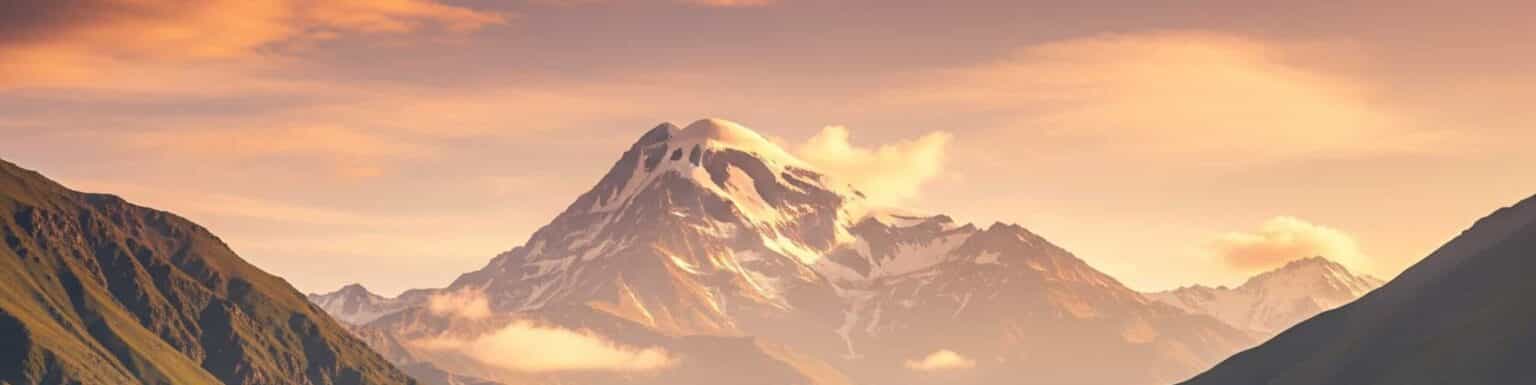
Mount Kazbek (5,054 meters) functions as the accessible high-altitude introduction to serious Caucasian mountaineering. Technically rated “moderate for a 5,000-meter peak,” the classical southern route via Bethlemi Hut demands crampons, ice axes, rope work, and crevasse navigation—basic glacier travel skills rather than advanced rock climbing. The summit day involves approximately 12 hours and 3,300 meters elevation gain, requiring excellent fitness and altitude acclimatization. No technical experience required for the classical route, differentiating Kazbek from steeper Alpine summits; countless first-time mountaineers succeed with proper guides and acclimatization strategy.
Summit success rates improve dramatically with multi-day acclimatization schedules: staying at the Bethlemi Hut (3,650 meters) for 2+ days, summiting a nearby 4,000-meter+ peak first, then attempting the main summit maximizes physiological adaptation and reduces altitude-sickness risk. Pricing ranges €860-1,155 for group tours to €1,500+ for private expeditions, positioning Kazbek as affordable introduction to 5,000-meter climbing.
Mount Kazbek + Mount Elbrus combination (13-14 days, €1,500-2,500) leverages Kazbek’s lower altitude and technical complexity as acclimatization for Elbrus (5,642 meters, Europe’s highest peak), which proves physically more demanding but technically less challenging. This combination remains popular for climbers targeting both Caucasian giants within single expedition window.
Seasonal Optimization: Timing Critical for Access and Safety
July-August represent peak hiking season with optimal weather stability, longest daylight hours (5:30 AM sunrise to 9:30 PM sunset in July), and complete trail accessibility. Temperatures moderate with elevation: mountain areas (2,000-3,000 meters) average 12-22°C (54-72°F), while high-altitude zones (3,000+ meters) reach only 8-15°C (46-59°F) even at height of summer. Despite optimal conditions, peak season brings commensurate crowding and accommodation pressures requiring advance booking 1-2 months prior.
May-June and September (shoulder seasons) offer compelling alternatives: cooler temperatures eliminate excessive heat while maintaining trail accessibility; Svaneti’s blooming alpine flowers (May-June) and Caucasus’s notoriously wet climate (September rainstorms trigger mist/low visibility) present distinct trade-offs. June and September specifically offer the “sweet spot”—superior weather predictability compared to May (muddy) or late September (rain increasing).
Critical seasonal reality: Tusheti closes entirely October through May due to snowpack rendering the Abano Pass impassable without mountaineering equipment—this non-negotiable constraint eliminates shoulder-season flexibility for Tusheti-focused itineraries.
Essential Pre-Hike Preparation
The Caucasus Mountains distinguish themselves through dramatically faster weather deterioration than Alpine systems: clear morning conditions transform into afternoon thunderstorms within hours; proper layering (base layers, insulation, weatherproof shell) proves non-negotiable regardless of season. Water filtration capacity exceeds water-carrying capacity—streams flow abundantly, but portable filters (Sawyer Mini, Lifestraws) eliminate 2-3 liter carrying requirements.
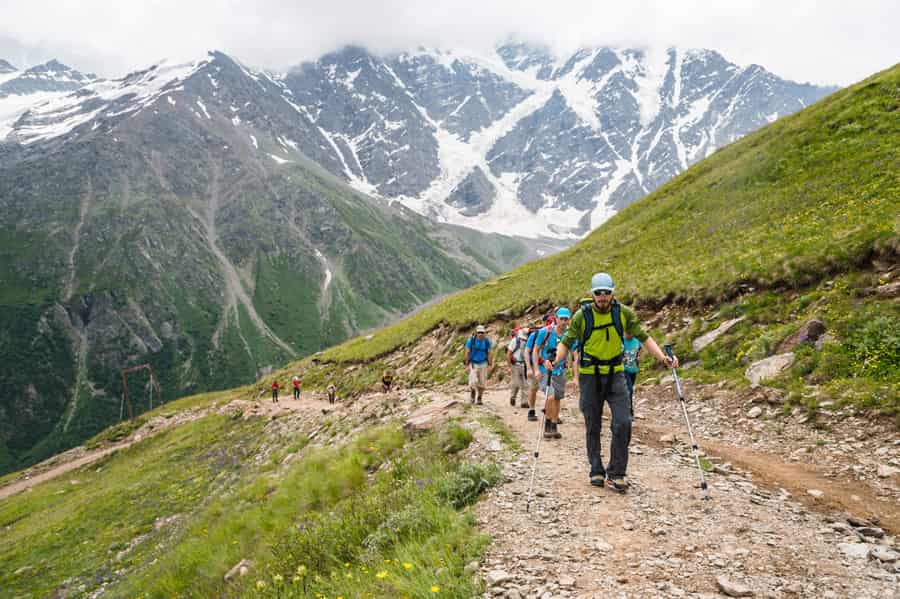
Proper hiking boots prove essential: loose rock, muddy descents, and stream crossings punish lightweight shoes with sprained ankles and blistered feet. Trekking poles significantly reduce knee stress on sustained downhill sections—hiking to Gergeti Church and multi-day treks alike benefit from pole utilization.
Georgia’s Caucasus Mountains ultimately deliver Alpine hiking experiences at fraction of Alpine costs, with remarkable seasonal diversity and cultural integration transforming routes from simple terrain-covering into transformative journeys through living heritage landscapes.